
Rodent Removal in Cabbagetown
Cabbagetown is a mill village of small wooden cottages on very tight lots, with the converted mill at its center. Small houses close together change how a rodent problem spreads and how it has to be solved.
- Mill village cottages
- Tight lots, close neighbors
- Loft buildings and the trail edge
What the mill village stock is like
Small, wooden, old and close together. Cabbagetown grew as housing for the Fulton Bag and Cotton Mill, and the surviving stock is largely 1880s to early 1900s shotgun houses and small cottages, most of them one story, on lots narrow enough that neighbors are within a few feet.
The construction is light. These are wood-framed houses on brick or stone piers with a shallow crawl space beneath, thin walls, minimal or no original insulation, and attics that are often little more than a void under a low roof. Many have been renovated once or several times, which has added penetrations and sometimes a rear addition with a different foundation from the original.
The practical consequence is that there is not much house between the crawl space and the living space. An animal under the floor of a shotgun cottage is closer to the kitchen than it would be in almost any other Atlanta housing type, and the noise carries accordingly.
What the renovations added
Five alterations show up repeatedly on cottages that have been reworked.
- Bathroom and kitchen penetrations through the floor, rarely sealed from below
- Rear additions on a different foundation, with an open junction between the two
- HVAC line sets and condensate drains through exterior walls
- New roofing over old framing, sometimes leaving the original eave detail untouched
- Crawl space access doors cut in new places and never properly hung
Why tight lots change the job
Proximity means a Cabbagetown rodent problem is rarely one house. When the distance between two foundations is a few feet, a population moves between them freely, and closing one house pushes the pressure next door rather than removing it.
Access is the other consequence. A contractor working a side elevation on a lot this narrow may not be able to get a ladder up in the usual position, and part of the foundation line may be reachable only from a neighbor's property. That is a scheduling and permission issue rather than a technical one, and it is worth raising at the inspection rather than discovering on the day.
What tends to help on a block like this
Five things make a job on a tight lot finish in a week rather than three.
- Talking to the immediate neighbors, since shared problems are cheaper to solve together
- Booking work when a neighboring renovation is not underway, if that can be arranged
- Clearing the side setback of stored items and planting so the foundation line can be reached
- Agreeing access across a boundary before the crew arrives
- Dealing with bins and their placement, which on a tight lot is often the food source
Each of those is the difference between a job that finishes in a week and one that needs three return visits to reach the last two openings.
The mill buildings and the trail edge
The converted mill buildings are a different structure type entirely and they are worth treating as commercial rather than residential in approach. Large masonry buildings with shared risers, connected basements and service areas behave like any older multi-tenant building: a problem in one unit is often a building problem, and treating a single loft changes little.
Where that is the situation, the useful work is at the building level rather than the unit level: the service and waste areas, the basement and any sub-level, the risers and chases that run vertically, and the loading or delivery points. That work is covered under commercial rodent control, and a unit owner is usually better served by raising it with the association than by treating one apartment.
The trail and rail corridor along the edge of the neighborhood is a landscape feature rather than a source, and it is worth being precise about that rather than dramatic. Green corridors provide cover and travel for a lot of wildlife, and dense vegetation up against a foundation line is harborage wherever it occurs. Keeping the ground clear along the back of a lot that adjoins the corridor is sensible maintenance.
A representative closure on a Cabbagetown cottage
The most common job on this stock is closing the shallow crawl space under a small wooden cottage. The perimeter is usually a mix of original brick piers, later infill, and at least one section where a renovation left a gap behind stored items or planting on a narrow side setback.
The closure runs the full perimeter rather than the visible parts of it, with galvanized mesh carried down and turned into the soil so nothing digs beneath, new screening behind whatever vents exist, and the access door rehung in a frame with a latch. Where a rear addition sits on a different foundation, the junction between the two is treated as its own opening, because it is frequently the largest one on the property and the one a previous contractor walked past.

What is moving inside the walls
How noise in a wall cavity gets traced.
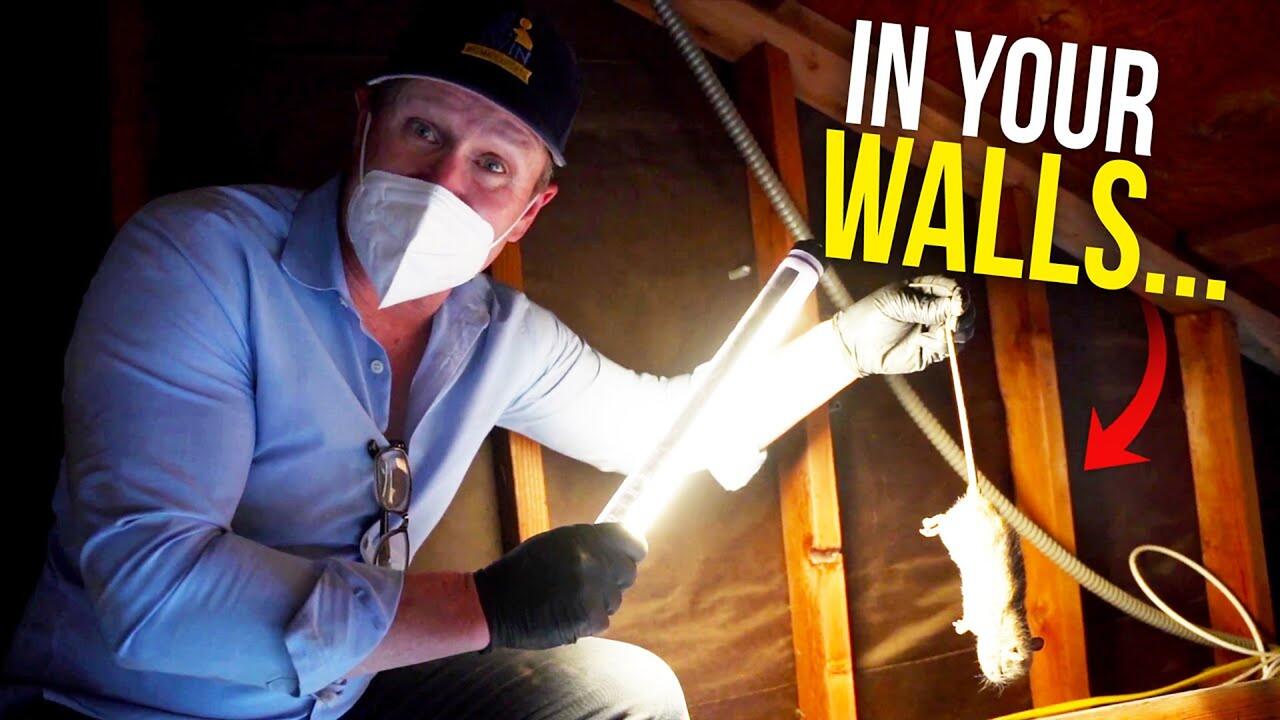
Video: Rodents in your walls? Here's what you do, from Twin Home Experts.
Why Cabbagetown needs a full perimeter
Small houses, short distances
There is very little structure between a shallow crawl space and the floor of a shotgun cottage, so an occupancy below is audible and reachable in a way it would not be in a larger house. That works in your favor during trapping and against you during the weeks before anyone calls, which is why these jobs benefit from being caught early.
Norway rats and house mice work at foundation and crawl space level.
The whole perimeter, including the neighbor's side
On a lot this narrow, part of the foundation line is often reachable only from a boundary, and a closure that stops at the accessible elevations is not a closure. Access is agreed before the crew arrives rather than negotiated on the day, and the quote states which elevations are included so nothing is left out without being named.
UF/IFAS sets the rat-proofing threshold at a quarter of an inch.
Addition junctions are the missed opening
Most of these cottages have a rear addition on a different foundation from the original, and the junction between the two is commonly the largest opening on the property. It is also the one a quick survey misses, because it sits at the back of a narrow lot behind whatever has been stored there. It gets treated as its own line item.
Renovation penetrations are frequently the entry point rather than original construction.
A common Cabbagetown call
The situation: A caller in a small 1890s cottage hears movement directly under the floor of the front room in the evenings, close enough that it wakes the dog. The house has a rear addition built about twenty years ago and a side setback of roughly four feet.
What gets done: The inspection finds the original crawl space largely intact and the junction between the old house and the addition wide open at ground level behind a stack of stored lumber. Two vents on the accessible elevation have lost their screening and the far elevation cannot be reached without going onto the neighboring lot. The quote covers closing the addition junction, screening the vents, rehanging the access door, and a trapping program, with the far elevation noted as requiring access permission.
How it turns out: The neighbor agrees access, the stored lumber is moved, and the full perimeter is closed over two visits. Traps under the front room produce for five nights and stop. The front room goes quiet and the dog stops standing over the same floorboard every evening.
Cabbagetown questions
Four answers on small houses, neighbors, the mill buildings and cost.
Call (404) 924-6653My neighbor has the same problem. Should we do it together?
On lots this narrow it is usually cheaper and more effective. A population moving between two foundations a few feet apart is one population, and closing one house pushes the pressure across rather than removing it. Coordinating also solves the access problem, since both properties are needed to reach both foundation lines properly. Each house is still inspected and quoted separately, so nobody is paying for work on somebody else's building.
Part of my foundation can only be reached from next door. What happens?
Access gets agreed before the crew arrives and the quote says which elevations are included. A closure that covers three sides of a house is not a closure, so where permission cannot be obtained, that limitation is written down rather than hidden, along with what it means for the result. Most neighbors agree once they understand that an unclosed elevation feeds both houses.
I live in one of the mill lofts. Is this the same job?
It is closer to a commercial job than a residential one. A large masonry building with shared risers, connected basements and service areas behaves as a single site, so a problem in one unit is usually a building problem and treating the unit alone changes little. The useful work is at the waste areas, the basement, the vertical chases and the delivery points, which is covered under commercial rodent control and is best raised with the association.
What does a cottage job cost here?
Small houses cost less than large ones, and Angi's Atlanta rat removal band of $442 to $1,138 with an average around $786 covers the trapping. HomeGuide's 2026 national guide puts full-home exclusion at $500 to $2,500, and a small cottage with a shallow crawl space usually sits at the lower half of that unless there is an addition junction or carpentry involved. Access difficulty on a narrow lot is the thing most likely to push it up. The free inspection produces the itemized quote.